
Running a Sex Offender Check in Limestone County
The primary public channel is the Alabama Law Enforcement Agency Sex Offender Registry search. ALEA's Criminal Justice Information Services division maintains the statewide database. Limestone County law enforcement registers people, verifies changes, and forwards the registration data, fingerprints, and current photograph. ALEA says those local submissions update the public database daily in real time.
Use the state search for Alabama detail. Start with a name when one is known, or use place fields to look at a Limestone County area. Then open the full result and compare more than a name. Age information, physical traits, address, offense data, and status help distinguish people with similar names. The ALEA registry information page explains the limits placed on public coverage.
The official ALEA explanation is shown in the manifest image below.
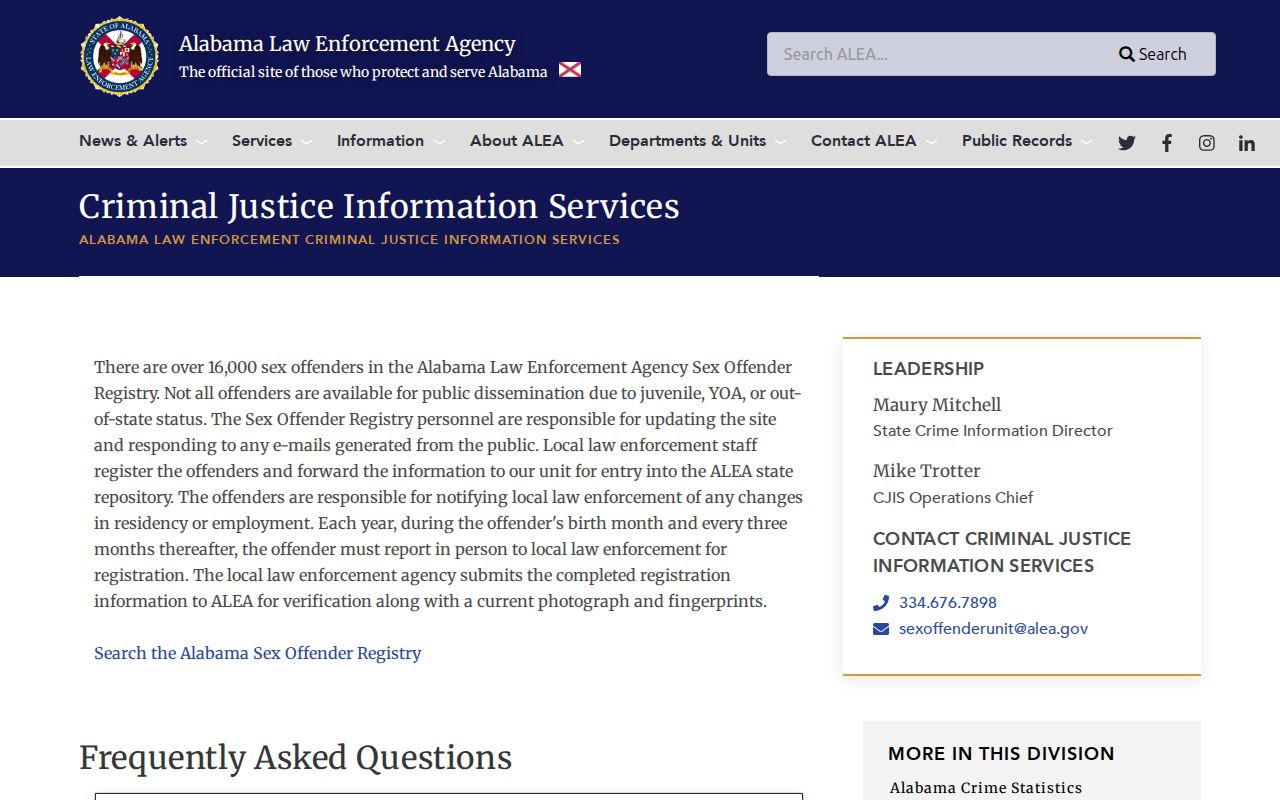
That source matters because a Limestone County sex offender check must be read under Alabama's rules, not as an all-purpose criminal history report.
Limestone County Registry Verification Cycle
Adult registrants report in person during their birth month and every three months after that. During an update, local law enforcement submits current registration information to ALEA, including a photograph and fingerprints. This repeated local-to-state cycle explains why the Limestone County registry may change even when the underlying conviction stays the same. A new address, vehicle, school, employer, or status entry can alter what a public profile displays.
The Limestone County Sheriff's public page does not identify a separate sex-offender counter or publish special registration hours. The verified starting point is the Sheriff's Office at 101 West Elm Street in Athens. Call 256-232-0111 before visiting to confirm the current appointment site and process. The county contact directory lists public office hours as Monday through Friday, 8:00 a.m. to 4:30 p.m.
The Limestone County department directory helps keep this route distinct from the Circuit Clerk, courts, and other county offices that do not operate the registry counter.
Limestone County Sheriff's Office
101 West Elm Street
Athens, AL 35611
256-232-0111
Searching the ALEA Sex Offender Registry
The ALEA interface supports both identity and location criteria. Vendor controls prevented automated confirmation of every current label and radius choice, so use the controls shown on the live form rather than assuming a fixed set of miles. No private profile must be opened simply to learn the search layout.
- Open the official ALEA public search and read its conditions and warning.
- Enter a name, or narrow the location with Limestone County, a city, ZIP code, or address-based control.
- Review the list or map, then compare enough public identifiers to avoid a mistaken match.
- Open the relevant profile and read its offense, address, registration, and compliance fields in context.
| Search control | Type | Required | Use |
|---|---|---|---|
| Name | Text | No single field confirmed | Search by the person's name |
| City/Town | Text or dropdown | Optional | Narrow to an Alabama community |
| County | Dropdown | Optional | Select Limestone |
| ZIP Code | Text | Optional | Focus on a postal area |
| Address/radius | Address and dropdown | Optional | Use the live radius options displayed |
| Search/map/list | Controls | As displayed | Switch among available result views |
The official ALEA public search form is captured below without centering any private person's record.
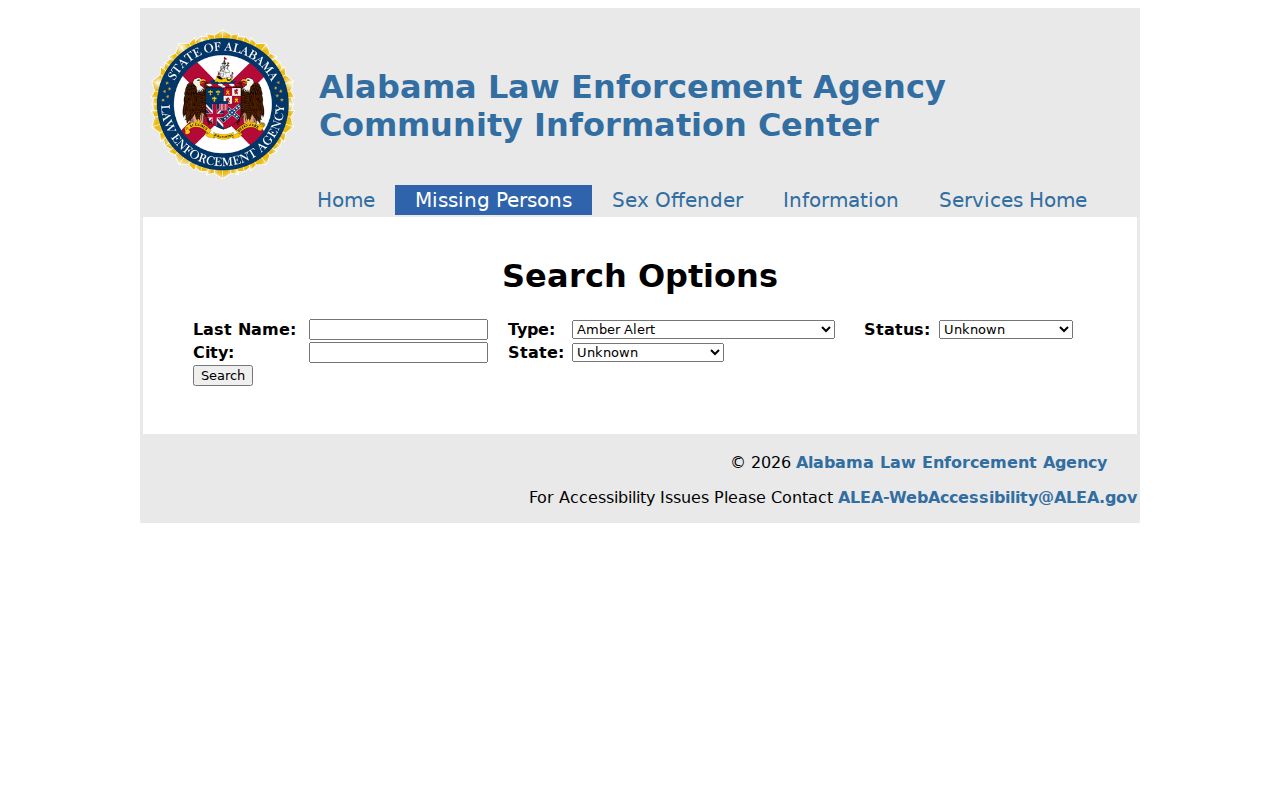
The live portal remains the controlling source when its options differ from an older image or description.
Limestone County Registry Search Gaps
A blank Limestone County search does not prove that no sex-offense case or adjudication exists. ALEA identifies juvenile matters, Youthful Offender cases, and some out-of-state due-process situations as reasons a matter may not appear publicly. Alabama also limits registration to offenses covered by Ala. Code § 15-20A-5. A first conviction for indecent exposure or sexual misconduct can be registration-only under the statute.
Timing also matters. Public appearance follows conviction and release through probation or completion of a sentence, not the date of arrest. An arrest entry, pending charge, court file, and registry profile answer different questions. For the outcome of a Limestone County prosecution, the criminal court case record is the better source. The registry is for current public registration information.
The official registerable-offenses statute shown below is the correct place to check the legal list.
Act 2026-375 changes that section on October 1, 2026, so searches after that date should use the then-current version.
What a Registry Profile Shows
An Alabama public profile can combine identity, location, offense, and compliance details. The exact public set depends on the law and the record. Compare several fields before treating a result as a match, especially when the name is common. A profile is a public registration record, not a full case transcript or a statewide fingerprint history.
| Name and aliases | Names used to identify the registrant |
|---|---|
| Photo and description | Current photograph and available physical traits |
| Age information | Date-of-birth or age details when public |
| Registered address | Residence information authorized for public display |
| Offense and conviction | Registerable offense and related conviction data |
| Status | Registration or compliance information |
| Other public fields | Employer or school, vehicles, and scars, marks, or tattoos when releasable |
The Alabama registry information statute is pictured in the source-linked image below.
Reading the statute with the live Limestone County profile helps separate a field that may be collected from one that may be shown publicly.
Limestone County Registry Data Boundaries
Alabama Administrative Code rule 760-X-3-.03 requires secure collection of more data than a public profile necessarily reveals. The registration record may include SID, FBI, and AIS identifiers, Social Security number, passport information, and other sensitive fields. Their collection supports identity and law-enforcement administration. It does not mean a visitor should expect every item on the public Limestone County registry page.
This distinction prevents two common errors. First, an absent public field is not proof the registering agency failed to collect it. Second, the public page should not be treated as a complete agency file. Questions about what may lawfully be released belong with ALEA or the Limestone County Sheriff's Office, while correction concerns should be reported through an official channel.
The official Alabama registration-information rule is represented below.
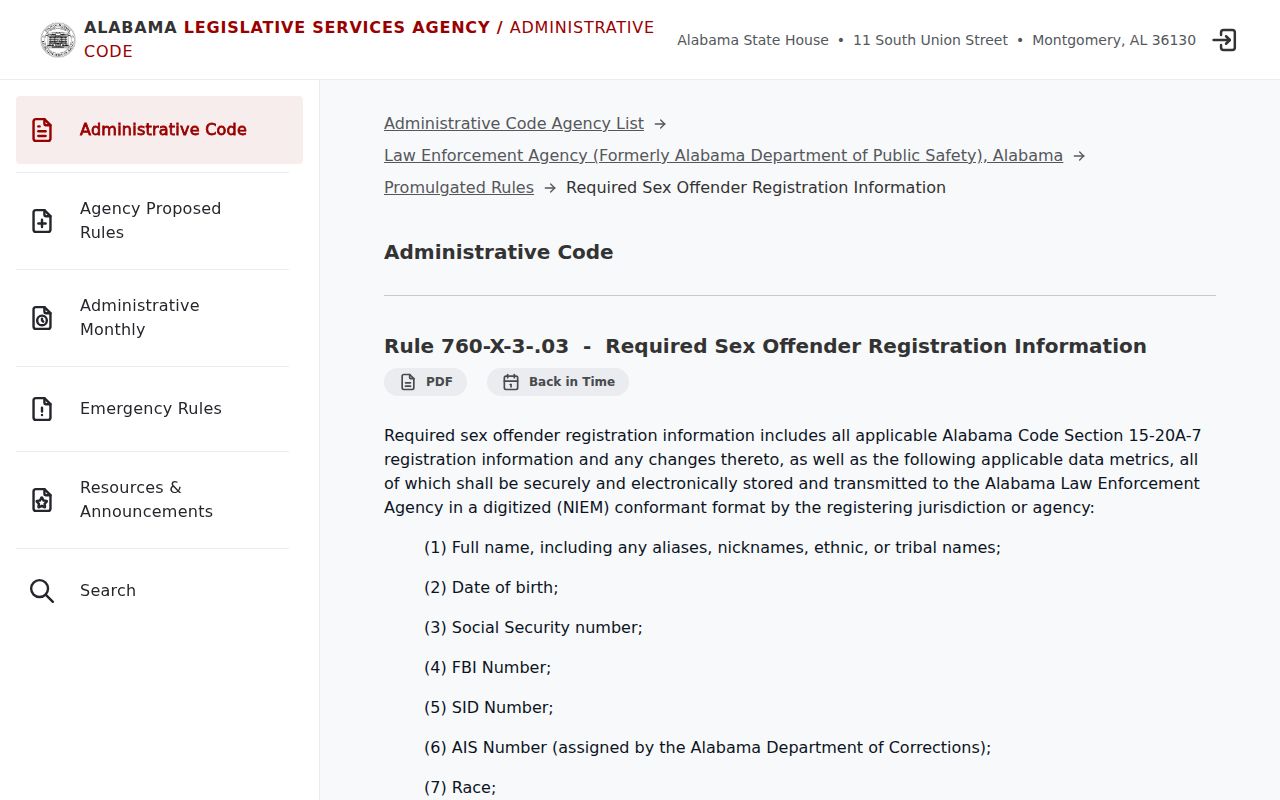
The rule gives the necessary context for why secure registration fields and public profile fields are not identical lists.
Registration Requirements and Levels in Alabama
Alabama does not use the federal Tier I, II, and III chart as its state duration table. Adult registration is generally for life, subject to limited statutory relief. Juvenile duration and notification depend on age, offense category, and a court's risk determination. Importing a federal tier label into a Limestone County result can therefore give the wrong account of both duration and notice.
| Alabama category | Duration | Public-notification treatment |
|---|---|---|
| Adult sex offender | Life under § 15-20A-3(b), with limited relief | Generally public when SORCNA dissemination rules apply |
| Specified serious juvenile offense, age 14+ | Life; petition may be possible after 25 years | Court risk finding controls notice |
| Other juvenile sex offender | 10 years from first registration | Risk-based |
| Juvenile low risk | Applicable term | Confidential school-specific notice |
| Juvenile moderate risk | Applicable term | Schools and child-care facilities within three miles |
| Juvenile high risk | Applicable term | Public notice comparable to adult notice |
Adults also report in person in their birth month and every three months thereafter. That verification schedule is separate from how long registration lasts. For juvenile categories, Ala. Code §§ 15-20A-27, 15-20A-28, and 15-20A-34 control the risk and relief framework.
Limestone County Checks Across States
ALEA offers the state-law detail needed for an Alabama result. The Department of Justice National Sex Offender Public Website adds a cross-state search layer. NSOPW is useful when a person may have moved or when a place-based check crosses a state line, but it draws from participating jurisdictions and does not erase the need to read the source registry's own fields and limits.
For a Limestone County search, begin with ALEA to use the Alabama county, city, ZIP, and address tools. Use NSOPW as a supplement when the inquiry is not confined to Alabama. If the two displays seem different, return to the originating registry and local law enforcement instead of trying to merge the records by assumption.
The official national registry search appears in the following manifest image.
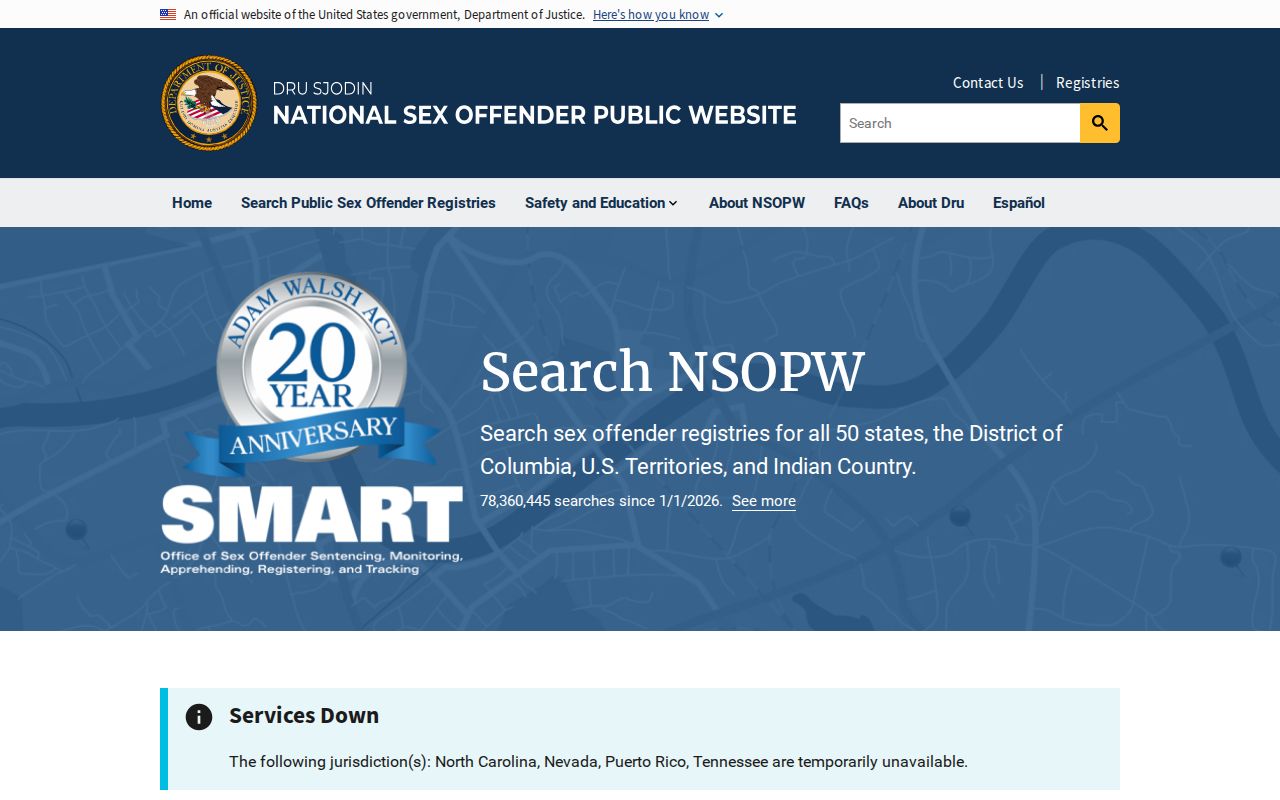
This federal search broadens geography, while ALEA remains the detailed Alabama source for Limestone County entries.
Lawful Use and Community Notification
Registry information exists for safety awareness and lawful community notification. It is not a license to confront a listed person, enter private property, or target a household. Alabama's notification system also treats juvenile risk categories differently. Low-risk notice can remain confined to a school setting, moderate-risk notice reaches schools and child-care facilities within three miles, and high-risk notice is comparable to adult public notice.
The current dissemination and warning rules are found in Ala. Code §§ 15-20A-7 and 15-20A-8. Read a result with care, verify the match, and let law enforcement handle suspected violations. Public access does not replace due process or authorize action against a registrant.
Alabama anti-harassment warning: Ala. Code § 15-20A-8 requires a warning that misuse of registry information to injure, harass, or commit a crime against a registrant, family member, or employer is unlawful.
Correcting Limestone County Registry Concerns
Report a suspected wrong Limestone County address, proximity violation, or unregistered person to local law enforcement. Do not investigate at the residence. Call the Limestone County Sheriff's Office at 256-232-0111 and describe the concern without confrontation. For a state-registry question, ALEA's Sex Offender Registry Unit lists 334-676-7898 and sexoffenderunit@alea.gov.
Give the agency enough detail to find the public entry, such as the displayed name, address, and the point that appears inconsistent. Avoid sending sensitive documents until the agency confirms a secure method. Local officers can check registration facts and submit corrected data, while ALEA manages the public statewide database.
Keep the roles distinct. The Sheriff's Office is the verified local starting point, ALEA controls the Alabama registry, and NSOPW supplies a national search layer. That reporting chain offers a lawful response when a Limestone County registry result appears incomplete or wrong.